This guide is part of the Reclaim Your DNA research library. It helps readers understand Nigerian heritage, the Benin Bronzes, the 1897 looting of Benin City, and the modern movement for cultural restitution through context, evidence and a concrete path to action.
Use this guide after the Reclaim Your DNA campaign background, then continue with the petition and the full research library. It complements our guides to tracking title, return and loans, Nigerian public records, private-collection due diligence, and university collections.
Why official agreements matter after a restitution headline
A restitution headline can be emotionally powerful, but the public record has to answer more than whether a return was announced. Readers need to know what was transferred, who now owns the objects, where the objects are physically held, what institution is accountable for the next update, and how Nigerians will be able to study or visit the returned heritage. Without those details, a return story can become a symbolic celebration that leaves the practical status unclear.
This is especially important for the Benin Bronzes because the 1897 looting of Benin City created both a material displacement and a records problem. Objects were removed in a violent colonial expedition, then moved through soldiers, dealers, auction rooms, private collectors, museums, university collections and state repositories. A modern agreement is one way to repair that record. It should not hide behind diplomatic language. It should tell the public how the institution has recognized evidence, how title has changed, and what happens next.
The campaign value is simple: source-backed advocacy becomes stronger when supporters can read agreements carefully. A reader who understands the difference between a promise, a legal transfer, a handover ceremony, a loan and a public access plan can ask better questions. That kind of literacy helps protect restitution from two opposite mistakes: treating every announcement as complete repair, or dismissing real progress because it still has unfinished stages.
Start with the evidence named in the agreement
A strong restitution agreement begins with evidence. It should name the Kingdom of Benin, Benin City, the 1897 British military expedition or other documented route, and the collection history that connects a specific object or group of objects to the claim. The British Museum's own contested-objects material explains that British forces attacked and occupied Benin City in 1897 and that works from the city entered collections after that event. Digital Benin then helps readers connect object records, provenance notes, institutional holdings, archival material and Edo-language knowledge across dispersed collections.
Evidence does not have to mean that every line of custody is perfect. Many records from colonial collecting are incomplete, euphemistic or scattered. A responsible agreement can state what is known and what remains uncertain. The key is that uncertainty should not be polished into silence. If an object belongs to a category widely dispersed after the 1897 looting, but the exact dealer route is incomplete, the public should be told both facts. If a museum acquired an object in 1905, the acquisition date should not erase the earlier violence that made the market possible.
Readers can use this as a practical test. Does the agreement identify the objects clearly enough to compare them with Digital Benin or a museum catalogue? Does it cite the 1897 context directly rather than using soft words such as 'collected' or 'acquired'? Does it separate the object's original cultural context from the later institutional accession? If the answer is no, the announcement may still be useful, but it is not yet an adequate public record.
Separate title transfer from physical custody
Legal title is the first major status question. When ownership transfers to Nigeria's National Commission for Museums and Monuments, another Nigerian authority, or an agreed structure involving the Benin Royal Palace, the object is no longer being described as a foreign museum possession waiting for goodwill. It is Nigerian heritage whose custody, display, loan or conservation path should be decided under Nigerian authority. That distinction is not a technicality. It changes the ethical grammar of the whole record.
Physical custody is a second question. An object may have title transferred before it travels. It may be physically handed over at a ceremony. It may remain temporarily abroad on an approved loan after ownership changes. It may require conservation, insurance, packing, transport, import procedures or display planning before it is visible to the public. A clear agreement should therefore distinguish title from location. Saying that an object was returned should not force readers to guess whether that means legal ownership, physical shipment, both, or a staged process.
The Netherlands return shows why precision matters. In 2025, Dutch and Nigerian authorities publicly described the return of 119 Benin Bronzes to Nigeria, with the Dutch government emphasizing that Nigeria would decide where and how the objects would be displayed. That language is materially different from a vague partnership announcement. It points to state-level restitution and Nigerian decision-making. A campaign reader should capture that status clearly, then keep asking how object records, exhibition access and public education will reflect it.
Read recent institutional examples as status models
Recent returns offer a set of models that readers can compare. The Smithsonian announced in 2022 that its National Museum of African Art transferred ownership of 29 Benin Bronzes to Nigeria's National Commission for Museums and Monuments, explicitly connecting the objects to the 1897 British raid. The Horniman Museum announced the return of ownership of Benin bronzes to Nigeria and acknowledged the forceful removal of objects from Benin City. These announcements mattered because they joined ethical language to an ownership action.
University cases add another layer. Cambridge announced in February 2026 that legal ownership of 116 Benin artefacts had been transferred to Nigeria's NCMM under a management agreement involving the Benin Royal Palace. The University of Zurich announced in 2026 that it would return 14 Benin objects to Nigeria after provenance research. For readers, the educational point is not only the object count. It is the status language: ownership transfer, return decision, management agreement, Nigerian authority, and the relationship between research and action.
These examples should increase pressure on institutions that still rely on open-ended study. Provenance research is necessary, but it should lead to decisions where the evidence supports return. A museum or university that says it is researching Benin objects should be able to state its timetable, its evidence standard, its contact with Nigerian institutions, and what result will follow if the 1897 link is established. Research without a public decision path can become delay.
Ask whether Nigerian authority is visible
A restitution agreement is weaker if it centers the returning institution as the hero and leaves Nigerian authority in the background. The public should be able to see who receives title, who approves custody, who speaks for national museum responsibility, how Edo cultural authority is considered, and what future record will show. Nigeria's National Commission for Museums and Monuments is central because it is the statutory public institution for museums, monuments and national heritage stewardship. Agreements should not treat that authority as a ceremonial footnote.
The role of the Benin Royal Palace also matters because the objects are tied to the Kingdom of Benin, royal history, guild knowledge and Edo cultural memory. Different agreements may structure national and palace roles differently, but they should not make readers guess whether the cultural source community is part of the process. The public conversation is strongest when it can name both Nigerian state responsibility and Edo cultural meaning without turning either into a slogan.
This is where Digital Benin and Nigerian public records should work together. Digital Benin reconnects dispersed object data and Edo knowledge across institutions. Nigerian institutional updates can state ownership, custody, access and future display plans. A responsible foreign museum record should link outward to these resources or at least make the Nigerian status visible in the same place where visitors encounter the object.
Public access is a duty, not a decoration
The ethical case for restitution begins with ownership and authority, but it does not end there. Once title is restored or physical objects return, the public has a right to ask how the heritage will become teachable. Will there be Nigerian museum displays? Will schools have reliable materials? Will researchers be able to access object records? Will diaspora communities be able to follow the status from abroad? Will labels explain 1897, provenance, title and custody in plain language?
Public access does not mean that every returned object must immediately sit in a gallery. Conservation needs, sacred restrictions, security, loan agreements and research priorities may shape access. The point is transparency. If an object is in storage for conservation, say so. If it is part of a future exhibition, give the public a credible update path. If digital records are pending, name what will be added. Public trust grows when institutions describe practical stewardship rather than hiding behind vague celebration.
The Reclaim Your DNA campaign connects this to cultural education. A returned object should help Nigerians and the diaspora understand court history, artistic skill, colonial violence, modern repair and living cultural confidence. That is why the article library links history, object records, teaching materials, public access and action. Restitution is not only an institutional transaction; it is a learning system that should bring cultural memory back into public use.
Use international ethics frameworks without letting them replace return
UNESCO, ICOM and UNIDROIT materials give readers useful language for illicit trafficking, museum ethics, documentation, due diligence and return. They are important because they show that cultural property is not merely a private possession question. Museums and states operate inside ethical and legal expectations that require provenance research, respect for source communities, transparent records and cooperation in return or restitution processes.
Those frameworks are not a loophole for avoiding the Benin question. The famous 1897 Benin removals predate some modern conventions, but the ethical issue remains current because the objects remain in present-day institutions. A museum cannot answer the colonial history simply by saying that a later acquisition was legal under the rules of its own market. A state cannot answer the public claim by treating heritage as a diplomatic bargaining chip. The question is whether the institution recognizes that colonial force created the possession and whether it will now restore authority.
For advocates, the right use of ethics frameworks is disciplined. Cite them to support documentation, transparent provenance, consultation and return. Do not pretend they solve every legal detail. Do not reduce the issue to paperwork alone. The stronger campaign position is that law, ethics, evidence and cultural memory should point in the same direction when the history is clear: toward Nigerian authority and accountable public access.
A reader checklist for every new return announcement
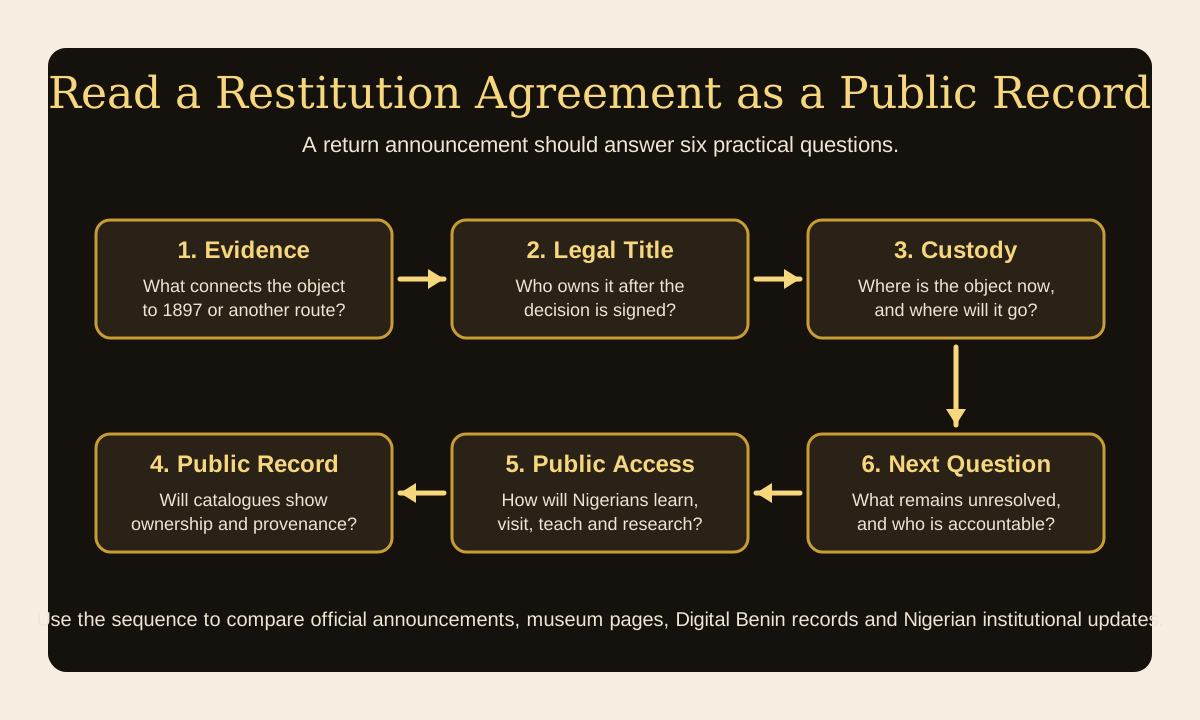
First, identify the objects. Record the count, object types, accession numbers if available, holding institution and the source link. Second, record the evidence language. Does the announcement name Benin City, the Kingdom of Benin, 1897, colonial expedition, looting, forced removal or another route? Third, record title status. Has ownership actually transferred, or has the institution only opened talks? Fourth, record physical custody. Are the objects already in Nigeria, scheduled for shipment, retained on loan, or still awaiting a handover process?
Fifth, record Nigerian authority. Name the receiving institution, NCMM role, palace role, government role, or any management agreement. Sixth, record public access. Look for museum display plans, digital records, education commitments, conservation work and update timelines. Seventh, record the next question. Every announcement leaves something to follow: catalogue updates, loan terms, physical movement, school access, public images, conservation capacity, or remaining objects in the same collection.
This checklist turns support into civic literacy. It helps a reader share a return announcement without exaggerating it. It helps journalists avoid treating a handover photograph as the whole story. It helps diaspora groups ask precise questions in public. Most importantly, it keeps the focus on repair rather than applause. The goal is not to make former holders look generous. The goal is to restore authority over heritage that should never have been separated by colonial violence.
What the next phase of accountability should look like
The next phase should be measured through records that ordinary readers can inspect. Every institution holding Benin objects should publish clear object pages, provenance notes, restitution status, title information and contact routes for correction. Every return should result in updated catalogue language, not only a press release. Every Nigerian public update should help families, teachers and researchers understand where the object is, who holds authority and how the public can learn from it.
Digital projects, museum agreements and government announcements should reinforce one another. Digital Benin can make the scattered archive searchable. Museum records can stop hiding behind passive acquisition language. NCMM and other Nigerian institutions can publish public-facing updates as objects return. Universities can use their teaching power to explain why title transfer matters. Diaspora readers can compare these records and support the petition with evidence rather than rumor.
The serious campaign tone is not anti-museum. It is anti-erasure. Museums can contribute research, conservation, digitization and education after return, but their role should change from possession to accountable partnership. An official restitution agreement is one of the places where that change becomes visible. Read it carefully, share it accurately, and use it to ask what still needs to be returned, recorded, taught and made accessible under Nigerian authority.
Frequently Asked Questions
What should an official Benin Bronzes restitution agreement explain?
It should explain the objects involved, evidence of removal, legal title, physical custody, Nigerian authority, public access plans and the next unresolved questions.
Is a title transfer the same as a physical return?
No. Title transfer changes ownership. Physical return changes location. A clear public record should state both, including any Nigerian-approved loan or staged handover.
Why do recent Netherlands, Cambridge and Zurich examples matter?
They show that governments and universities can move from provenance evidence to concrete return decisions, ownership transfer and Nigerian authority rather than endless research.
How can readers support the campaign after reading a return announcement?
Compare the announcement with official sources, save the status details, ask precise public questions, share accurate context and support the Reclaim Your DNA petition.
References and Further Reading
- Digital Benin
- Digital Benin: Catalogue
- British Museum: Benin Bronzes
- National Commission for Museums and Monuments
- NCMM: Netherlands returns 119 Benin Bronzes to Nigeria
- Government of the Netherlands: 119 Benin Bronzes returning home
- University of Cambridge: legal ownership of 116 Benin artefacts transferred
- University of Zurich: UZH returns Benin Bronzes to Nigeria
- Smithsonian: return of 29 Benin Bronzes
- Horniman Museum: return ownership of Benin bronzes
- UNESCO: Return and restitution
- ICOM: Code of Ethics
- UNIDROIT: 1995 Convention on stolen or illegally exported cultural objects