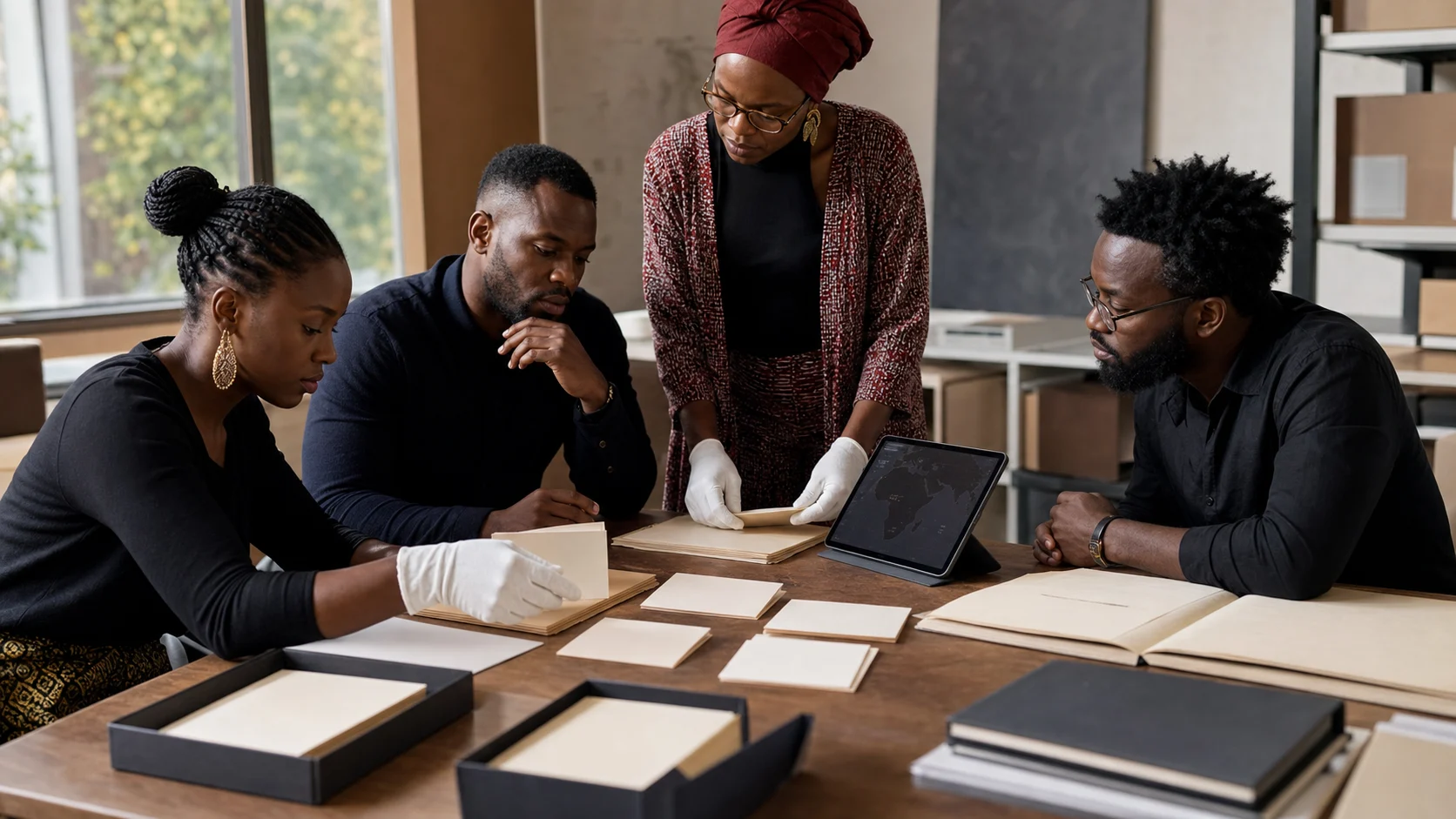
This guide is part of the Reclaim Your DNA research library. It helps readers understand Nigerian heritage, the Benin Bronzes, the 1897 looting of Benin City, and the modern movement for cultural restitution through context, evidence and a concrete path to action.
Use this guide after reading the campaign background and before signing the petition. It connects to our wider research library, especially the guides on museum object records, public access after return, tracking title transfer and loans, and teaching the Benin Bronzes.
Why labels become more important after restitution
Restitution does not end when a museum announces a transfer. For most visitors, students and families, the object label is still the place where the history becomes public. A label decides whether the Benin Bronzes appear as isolated works of art, colonial trophies, anonymous ethnographic pieces, or cultural objects connected to Edo knowledge, royal memory, violent removal, Nigerian authority and living education. After restitution, the label is not a small caption. It is a public accountability document.
A good label should be shorter than an academic essay, but it should not be vague. It should tell visitors what the object is, where it comes from, what is known about its role, how it left Benin City, who now has authority over it, and where readers can learn more. When a museum keeps a returned object on loan, the label should make that arrangement visible. When ownership has transferred to Nigeria, the label should not leave visitors with the impression that the former holder still owns the work.
This is especially important for the Benin Bronzes because their dispersal is not a mystery in the broad historical sense. Many works were taken after British forces occupied and looted Benin City in 1897. The British Museum's public page on contested objects names the 1897 expedition and the removal of thousands of palace objects. Digital Benin connects dispersed collections with object data, archival records, maps and Edo-language context. Serious interpretation should bring those records into the public label instead of hiding them in back-office language.
Start with the Edo context, not the museum inventory
The first test for a post-restitution label is whether it begins with the object's cultural world rather than the collecting institution's filing system. Accession numbers matter for research, but visitors need more than a number. They need to know whether the object is a plaque, a commemorative head, a figure, a bell, regalia, an ivory or brass work, or another form connected to the court, the Oba, ancestral remembrance, ceremony, diplomacy, craft knowledge or historical recording in the Kingdom of Benin.
Digital Benin is useful because it does not reduce the objects to one European museum vocabulary. It organizes records across global institutions while also foregrounding Edo names, oral history, object groups, archive links and contextual pathways. A label does not have to reproduce a full database entry, but it should learn from that structure. When a verified Edo term is available, it should appear with explanation. When the term is uncertain, the label can state that uncertainty rather than replacing local knowledge with a confident but narrow museum term.
This change matters for Nigerian cultural memory. A label that says only 'bronze plaque, acquired 1900' treats the object as an object of collection. A label that identifies its Benin court context, material, maker tradition, historical function and language context treats it as part of a cultural system. Restitution is not only about location. It is about restoring the public conditions under which the object can be understood by Nigerians, Edo communities, researchers, school groups and diaspora families.
Name the 1897 removal clearly when the evidence supports it
The second test is whether the label names the 1897 looting of Benin City when the evidence supports that connection. Many older labels use passive wording: 'collected', 'acquired', 'entered the museum', 'purchased from a dealer' or 'from Benin'. Those words may describe a museum transaction, but they often do not explain the source event that made the transaction possible. A post-restitution label should separate the original removal from the later acquisition route.
A precise label can say that the object was removed from Benin City during or after the British military expedition of 1897, then later sold, donated or transferred into a named collection. That wording is stronger than a general colonial-era reference because it gives visitors a date, a place and a mechanism. It is also more honest than using only the year the museum bought the work. The legal or administrative accession date should not erase the earlier violent displacement.
Museums sometimes worry that clear language will sound accusatory. For Benin material connected to 1897, clarity is not sensationalism. It is source-backed public history. The Smithsonian's return announcement, for example, directly connected its returned Benin works to the 1897 British raid and named the transfer of ownership to Nigeria's National Commission for Museums and Monuments. That is the standard visitors should increasingly expect: ethical action, legal clarity and historical naming in the same interpretive frame.
Separate acquisition, ownership, custody and loan status
The third test is structural: a label should not collapse acquisition, ownership, custody and loan into one vague sentence. These terms answer different public questions. Acquisition asks how the former museum obtained the object. Ownership asks who has legal title now. Custody asks where the object physically is and who is caring for it. Loan status asks whether the object remains abroad under an agreement made after Nigerian authority was recognized. Visitors should be able to distinguish all four.
Recent restitution announcements show why this distinction matters. Cambridge announced in February 2026 that legal ownership of 116 Benin artefacts in the Museum of Archaeology and Anthropology collection had transferred to Nigeria's National Commission for Museums and Monuments under a management agreement with the Benin Royal Palace. The announcement also said most physical transfers would follow later, while a smaller group would remain in Cambridge on loan and display for an initial period. A label in that setting should not imply that Cambridge still owns the works.
The Netherlands offers another example. In June 2025 the Dutch government announced the unconditional return of 119 Benin Bronzes to Nigeria, while noting that four works would remain on display in the Wereldmuseum under a loan agreement. Berlin's 2022 transfer of ownership of 512 Benin objects to Nigeria also included loan arrangements for a portion of the objects. These are not minor details. The label should tell visitors whether they are looking at an object owned by Nigeria, displayed abroad by Nigerian agreement, or still awaiting a different restitution decision.
Make Nigerian authority visible
The fourth test is whether Nigerian authority is visible in the label. If title has transferred to Nigeria's National Commission for Museums and Monuments, the label should say so. If a management agreement names the Benin Royal Palace, that relationship should be explained accurately. If a Nigerian institution has approved a loan, the label should state that the display is taking place under Nigerian authority, not as a courtesy granted by the former possessor.
This matters because public interpretation can lag behind legal reality. A museum may issue a press release about transfer, but leave gallery text, online records or educational pages in a voice that still centers the former holding institution. That mismatch weakens restitution. Visitors may read the old label and assume nothing has changed. Diaspora readers may see an object described as if its Nigerian authority is secondary. A serious post-restitution label updates the interpretive voice, not only the legal file.
Nigerian authority should not be treated as a decorative credit line at the bottom of the label. It belongs in the main object story. The label should explain who now owns the object, who governs access, who approved any loan, and where Nigerian public education or future display is expected to happen. This is not a demand for every label to become long. It is a demand for the label to stop hiding the most important governance facts.
Use Digital Benin as a bridge, not a substitute for return
Digital access is essential, but it is not a substitute for restitution. Digital Benin helps reconnect thousands of dispersed records and gives researchers, teachers and families a practical way to study objects that remain physically scattered. A strong museum label should point visitors toward that larger knowledge environment. It can link to a public record, name related archival material, or explain that the object is part of a wider dispersed corpus.
At the same time, digital records should not be used to soften the demand for physical and legal return. A museum cannot solve a colonial removal problem by uploading better images while keeping title unchanged. Digital work becomes ethically powerful when it supports transparency, provenance research, language recovery, teaching and Nigerian-led access. It becomes ethically weak when it is presented as an alternative to return. The label should make that distinction clear by linking digital learning to the restitution status, not by replacing it.
For readers, the practical takeaway is simple. When you see a Benin object online or in a gallery, compare the label to the Digital Benin record when one exists. Does the museum label include the same level of provenance candor? Does it name Edo context? Does it acknowledge 1897? Does it show current ownership? If the digital record is more honest than the wall label, the institution still has interpretive work to do.

Write for visitors without weakening the evidence
Museum labels have limited space, so interpretation must be disciplined. The answer is not to write a dense legal memo on the wall. The answer is to use a layered model. The short label should contain the essential facts: Edo context, 1897 removal when documented, former acquisition route, current ownership, loan status if relevant, and a path to more evidence. A QR code or web record can then carry a deeper provenance note, bibliography, timeline, glossary and teaching resources.
This approach helps different audiences. A first-time visitor can understand why the object matters in one minute. A student can follow the link and build a source packet. A Nigerian family can see whether the label recognizes Nigerian authority. A researcher can compare the public label with the object file. A museum educator can use the same structure in tours. The label becomes a doorway into evidence rather than a polished surface that keeps evidence out of sight.
The tone should also be careful. It should avoid both euphemism and theatrical overstatement. Words such as 'looted', 'removed', 'transferred', 'returned', 'loaned' and 'owned by' should be used where they match the evidence. Words such as 'gift', 'acquired' and 'collected' should not be used alone when the object's route depends on the violence of 1897. Serious language helps the public trust the institution because it shows that the museum is not protecting itself from the historical record.
Build labels with community review and teaching in mind
A restitution-era label should be reviewed not only by curators and lawyers, but also by educators, Nigerian cultural institutions, Edo knowledge holders where appropriate, and diaspora learning groups. That does not mean every sentence must become a committee compromise. It means the label should be tested against the audiences restitution is meant to serve. Can a school group understand it? Does it avoid colonial euphemism? Does it respect Nigerian authority? Does it give enough context for a family to continue learning after the visit?
Community review is especially important when labels use names, ritual descriptions, royal history or oral memory. Museums have often treated local knowledge as supplementary while treating the European collecting record as primary. A post-restitution approach should reverse that imbalance. The museum file remains important, but it should be placed alongside Nigerian and Edo interpretive authority. When disagreement or uncertainty exists, the label can say so. Honest uncertainty is better than a confident label built only from the old collection file.
For diaspora action, label review can become a practical campaign activity. Readers can document weak labels, compare them with public source records, ask museums to update language, and share better examples. This turns restitution advocacy into a concrete public education task. The aim is not to shame every imperfect caption. The aim is to make the public record catch up with the ethical reality that more institutions now recognize: Benin cultural heritage should be interpreted under Nigerian authority and with 1897 history in view.
A practical checklist for any museum label
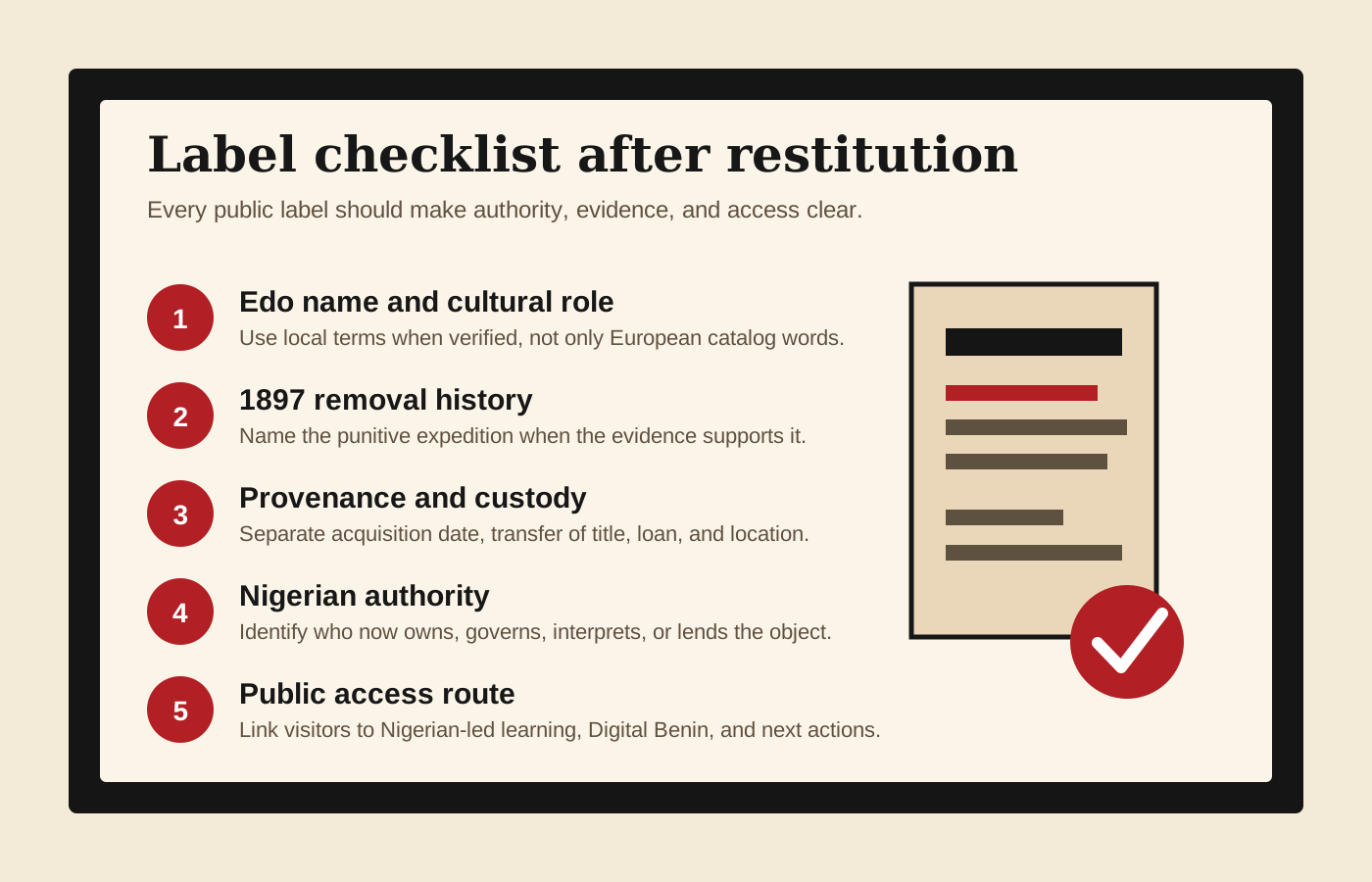
A useful label should answer six questions. What is the object, and what Edo or Benin court context can be stated responsibly? What is known about its function, material and maker tradition? What is the evidence for its removal from Benin City, especially any 1897 connection? How did it enter the former holding collection? Who owns it now, and who has authority over display or loan? Where can visitors go next for Nigerian-led learning, Digital Benin records, public access information or campaign action?
The label should also avoid six weaknesses. It should not use passive acquisition language as the whole story. It should not hide title transfer in a remote online note while the gallery label still centers the former owner. It should not describe a post-return loan as if it were ordinary museum possession. It should not use Digital Benin as a decorative link without naming restitution status. It should not turn Edo knowledge into a minor footnote. It should not make visitors guess whether the institution recognizes the 1897 history.
This checklist is useful for museums, but it is also useful for readers. Take a photograph of a label where allowed, or copy the online record. Compare it with the institution's restitution announcement, Digital Benin, NCMM statements, and major source-backed return notices. If the public label is weaker than the public evidence, write a precise request for correction. Ask for the missing fact, not a vague apology. Restitution advances when public interpretation becomes specific.
What better labels can do for the restitution movement
Better labels will not replace legal transfer, conservation, storage, Nigerian museum access or education funding. They are not the whole restitution movement. But they are one of the most visible ways to show that the movement has changed the public record. A museum that updates ownership but leaves old interpretive language in place is asking visitors to keep reading through a colonial lens. A museum that updates both ownership and interpretation is acknowledging that restitution changes authority.
For Nigerian institutions, better labels can support public trust. Visitors in Benin City, Lagos, Abuja or diaspora education spaces should be able to see how returned objects connect to history, court culture, creative knowledge and modern civic memory. For foreign museums displaying Nigerian-owned works on loan, better labels can make the loan honest. They can show that continued display is not possession by another name, but a time-limited arrangement under Nigerian authority.
For Reclaim Your DNA readers, the practical action is to read labels as evidence. Do not stop at the headline that a museum has returned objects. Ask what the wall text, online record, source list, school material and sitemap now say. Ask whether the museum names 1897. Ask whether Nigerian authority is visible. Ask whether the object is connected to a living public learning route. A good label does not close the case. It opens a more honest relationship between object, history and people.
Frequently Asked Questions
What should a museum label say after Benin Bronzes restitution?
It should state the object's Edo or Benin context where known, the 1897 removal history when supported by evidence, the former acquisition route, current ownership, custody or loan status, and a clear path to further Nigerian-led learning.
Is a digital record enough if the object has not physically returned?
No. Digital records are valuable for access, teaching and provenance research, but they do not replace legal title transfer, physical return where agreed, Nigerian governance or public access planning.
Why should labels mention loans?
Loans can be legitimate after ownership has transferred to Nigeria, but visitors need to know that the display is happening under Nigerian authority rather than continued possession by the former holding museum.
How can readers take action on weak museum labels?
Compare the label with official restitution announcements, Digital Benin records and Nigerian institutional statements, then ask the museum for a precise correction such as naming 1897, title transfer or loan status.
References and Further Reading
- Digital Benin
- British Museum: Benin Bronzes
- British Museum: Collecting histories
- Smithsonian: return of 29 Benin Bronzes
- Smithsonian National Museum of African Art: Benin Bronzes, Ambassadors of the Oba
- Horniman Museum: return ownership of Benin bronzes
- Government of the Netherlands: 119 Benin Bronzes returning home
- NCMM: Netherlands returns 119 Benin Bronzes to Nigeria
- University of Cambridge: legal ownership of 116 Benin artefacts transferred
- Staatliche Museen zu Berlin: Benin artefacts now in Nigerian hands
- Cambridge MAA: approach to the return of Benin bronzes
- UNESCO: 1970 Convention
- UNESCO: Return and restitution