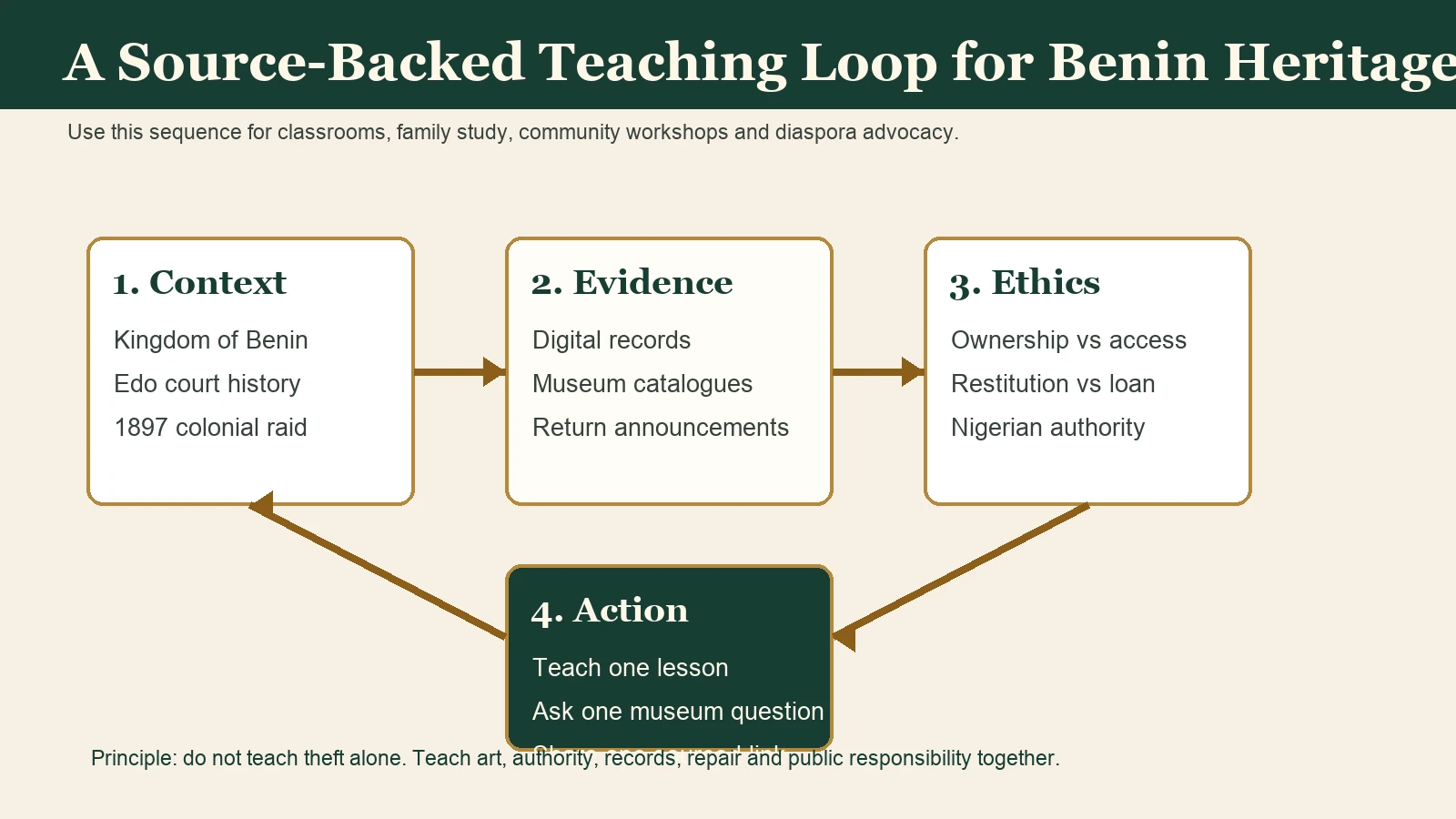
This guide is part of the Reclaim Your DNA research library. It helps readers understand Nigerian heritage, the Benin Bronzes, the 1897 looting of Benin City, and the modern movement for cultural restitution through context, evidence and a concrete path to action.
For new readers, begin with the Reclaim Your DNA story, then use this guide as a teaching plan for cultural memory. It links naturally to our guide on Digital Benin and provenance research, our article on the 1897 looting of Benin City, the wider blog archive, and the petition for public action.
Why teaching matters after every restitution headline
Restitution headlines are powerful, but they are not a curriculum. A museum can announce a transfer of ownership, a government can receive returned works, and a digital platform can publish records, yet many students may still know only a simplified version of the story: objects were stolen and should come back. That sentence is true as far as it goes, but it is too small for the cultural weight of the Benin Bronzes. A serious teaching approach must help readers understand art, power, court life, colonial violence, provenance, law, public access and living memory together.
The Benin Bronzes should not be taught only as evidence of loss. They should also be taught as evidence of Edo artistic skill, political order, historical documentation and spiritual authority. The plaques, heads, tusks, bells, regalia and other court objects were not generic decorations. They belonged to a system of meaning connected to the Oba, guild knowledge, palace ceremony, diplomacy, warfare, trade and ancestral memory. When a lesson begins there, restitution becomes more than the recovery of property. It becomes the recovery of a relationship between people, place and knowledge.
This matters because cultural education is one of the clearest ways to turn public sympathy into durable public pressure. A student who can explain 1897, read a museum record, distinguish a loan from a return, and name Nigerian-led access as the goal is harder to mislead. A family that can teach the story at home strengthens memory across generations. A diaspora group that builds one source-backed workshop can move the conversation from outrage into civic literacy.
Begin with Benin before beginning with Britain
Many public accounts start with the 1897 British punitive expedition because that event explains why so many Benin objects are now outside Nigeria. It is essential, but it should not be the first and only frame. If a class begins with British violence, students may absorb the false idea that Benin heritage becomes historically important only when Europe enters the story. A stronger lesson begins with the Kingdom of Benin as a sophisticated political and artistic society before explaining how colonial force interrupted access to its material memory.
Teachers can ask simple opening questions. What kind of society creates objects that record rulers, ceremonies, rank, trade, military achievement and spiritual continuity? What kind of skills are needed to cast brass, carve ivory, organize guilds and maintain court art across generations? What kind of archive exists when history is held not only in books, but in objects, names, ceremonies and public memory? These questions place Edo agency at the center before the lesson turns to removal.
This order also protects the lesson from trauma-only storytelling. The looting of Benin City was violent and must be named clearly. But students also need a vocabulary of dignity: craftsmanship, governance, cosmology, diplomacy, urban history, royal authority and contemporary Nigerian creativity. Restitution education should not reduce Nigeria to a victim position. It should show why the loss mattered so deeply: because what was taken came from a rich and continuous cultural world.
Use sources as learning tools, not decorative links
A source-backed lesson should put evidence in students' hands. Digital Benin is useful because it gathers object records, archival documents, historical context, Edo-language material and provenance information in one public platform. A teacher can use it to show how a single object may have a name, a category, a current holding institution, an acquisition trail and a wider cultural story. The point is not to turn every learner into a specialist curator. The point is to make records readable enough that vague museum language no longer feels sufficient.
Museum pages can then be compared rather than accepted passively. The British Museum's public pages acknowledge the 1897 expedition and describe Benin material within a contested collection context. The Smithsonian states that it transferred ownership of 29 Benin bronzes to Nigeria's National Commission for Museums and Monuments and identifies the works as taken during the 1897 British raid. The Horniman, Cambridge and the Dutch government provide additional examples of institutional return language. Each source has a different legal and curatorial voice, and that difference is itself a teaching opportunity.
Students should learn to ask what a source does and does not say. Does it name 1897 directly? Does it identify Nigeria, the Kingdom of Benin, Edo authority or NCMM? Does it describe legal ownership, physical custody, a loan, a display, or a future plan? Does it provide object-level records or only a press announcement? Evidence is not only a list of links at the bottom of an article. It is a method for reading power.
Teach provenance as a timeline of responsibility
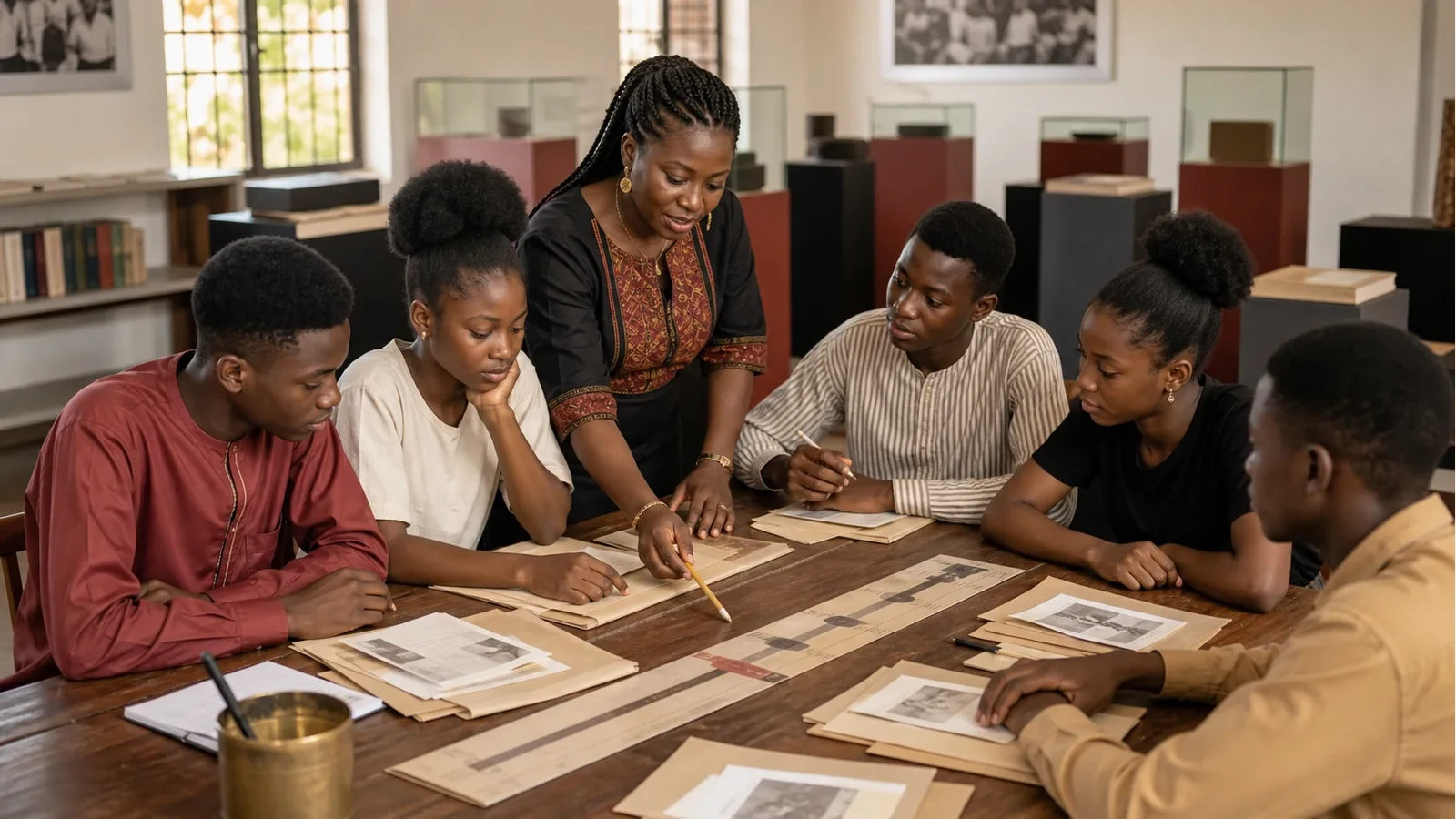
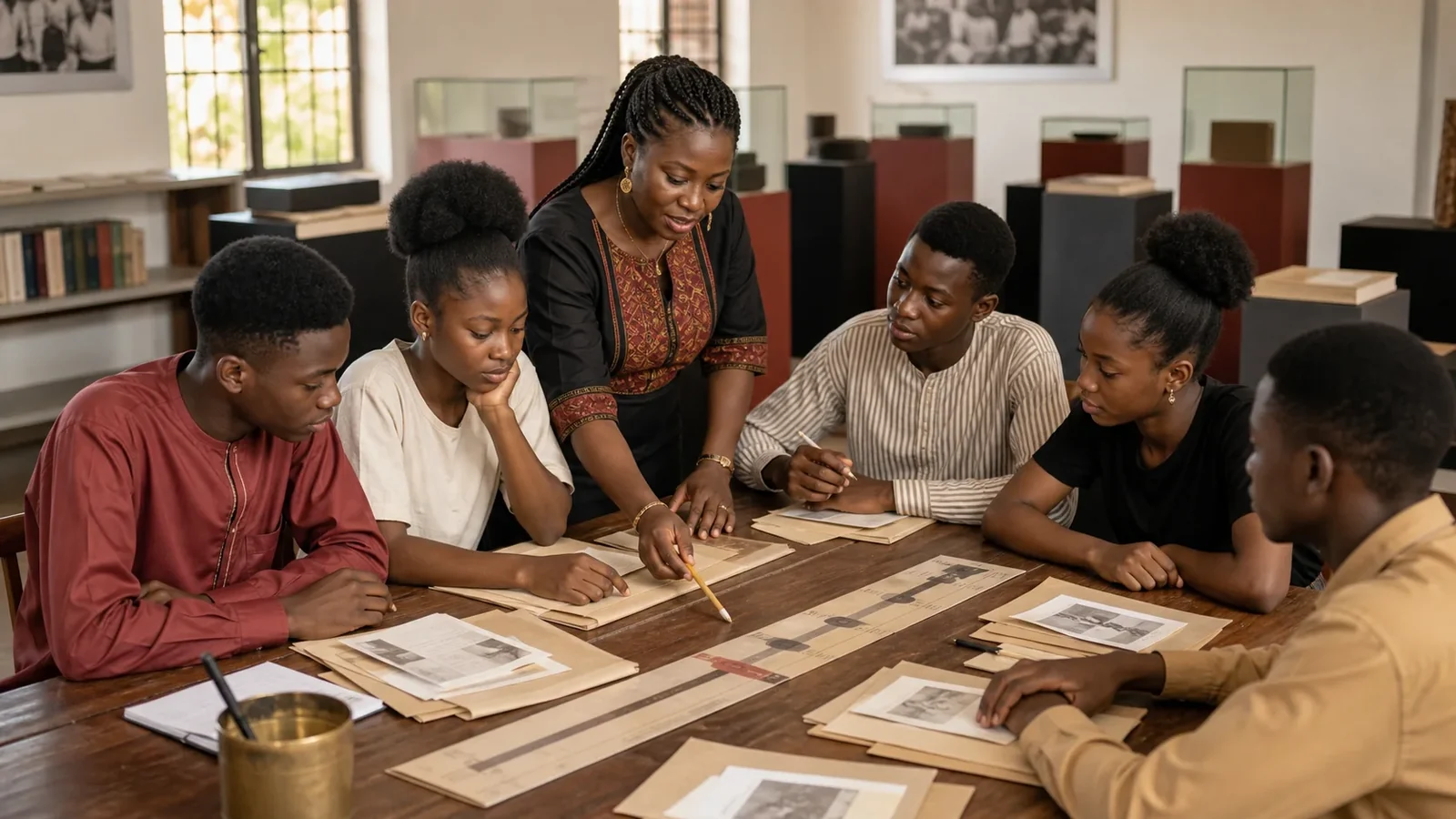
Provenance can sound technical, but it is one of the most teachable parts of the Benin Bronzes story. At its simplest, provenance asks where an object has been, who controlled it, how it moved, and what evidence supports that history. For Benin objects connected to 1897, the timeline begins with cultural life in the Kingdom of Benin, then moves through colonial attack, removal, sale, collecting, museum accession, research, public pressure and, in some cases, legal return.
A classroom timeline should avoid the neutral language that often hides violence. Terms such as acquired, collected or entered the museum may be accurate for one administrative step, but they can obscure the earlier coercive event. The British occupation of Benin City, the removal of palace objects and the later dispersal through markets and museums are not interchangeable with ordinary collecting. A careful teacher can show students how administrative words can soften historical responsibility.
The timeline also helps students understand why return is not a single global event. One institution may transfer legal title while some objects remain abroad on Nigerian-approved loan. Another may return physical custody. Another may still be researching records. Another may acknowledge contested history but keep the collection. Provenance education prepares readers to evaluate these differences without losing sight of the core ethical claim: objects removed through colonial violence should be subject to restitution, Nigerian authority and public accountability.
Explain the difference between access, ownership and authority
One of the most common arguments against restitution is that global audiences already have access to Benin objects in foreign museums or online catalogues. Teaching should separate three ideas that are often blended together: access, ownership and authority. Access means people can see or study something. Ownership means legal title is held by the rightful authority. Authority means the power to decide how the object is interpreted, displayed, loaned, conserved and connected to its community of origin.
Digital access is valuable, especially for diaspora readers, remote students and researchers who cannot visit Lagos, Benin City, Washington, London, Cambridge or another site. But digital access is not a substitute for title and custody. A high-quality image does not repair the fact that cultural authority was displaced. A museum database can help teach the story, but it should not become an argument for keeping the object under foreign control.
This distinction makes lessons more honest. A returned object may still be digitized for global learning. A Nigerian-owned object may be loaned abroad with permission. A foreign museum may still contribute research after title is transferred. None of those possibilities require the old assumption that Western custody is the natural center of world heritage. The teaching goal is not isolation. It is rebalanced access under the authority of the people and institutions to whom the heritage belongs.
Connect restitution ethics to international public standards
Restitution education should not pretend that every case is identical or that every legal question is simple. It should teach that cultural property debates operate across history, ethics, law, diplomacy, museum policy and public expectation. UNESCO's 1970 Convention addresses illicit import, export and transfer of ownership of cultural property, while UNESCO's return and restitution work provides a diplomatic forum for state-level claims and bilateral negotiation. These frameworks do not replace the specific history of Benin, but they help students see restitution as part of a global public standard.
The Benin case also shows why ethics can be stronger than narrow legal defensiveness. Some museums have returned or transferred ownership because they recognized that retaining objects taken in a colonial military raid was morally indefensible, even when local laws or institutional structures made action complicated. The Smithsonian's ethical returns policy, the Horniman's ownership transfer, the Dutch return and Cambridge's transfer of legal ownership all show that institutions can move when evidence, public pressure and leadership align.
Teachers should help students avoid two weak extremes. One extreme says law is all that matters, so colonial-era takings become permanent if they were absorbed into museum systems long ago. The other says emotion is all that matters, so facts become secondary. A stronger approach combines moral clarity with evidence. It says the documented history of 1897, the public record of dispersal and the growing pattern of institutional returns together create a serious obligation to repair.
Build a lesson around Nigerian museum access
A good teaching plan should not stop at asking foreign museums to return objects. It should ask what Nigerian public access can become after return. Nigeria's National Commission for Museums and Monuments is central because it is the federal institution responsible for museums, monuments, preservation and public heritage. Its digital museum work also shows that Nigerian access can be physical and digital at the same time, reaching people beyond a single gallery visit.
The Museum of West African Art describes work around research, conservation, storage, knowledge production and heritage management in Benin City. Whether students are studying NCMM, MOWAA, the Benin Royal Palace, university partners or diaspora initiatives, the key question is the same: how does return become public learning? Returned heritage needs conservation, records, teachers, local language interpretation, school visits, artist access, community consultation, disability access, affordable entry and responsible digital publication.
This is where cultural education becomes practical. Students can design a public-access checklist. Where is the object now? Who owns it? Can a Nigerian student find a record? Is there a display plan? Are teachers given materials? Are local communities involved? Is the foreign museum updating its catalogue language? These questions turn a classroom discussion into a civic habit.
Make diaspora workshops practical and repeatable
Diaspora groups do not need a museum budget to teach this subject well. A strong workshop can be built around four materials: a short history of the Kingdom of Benin, a sourced account of the 1897 looting, one Digital Benin object record or museum record, and one recent restitution announcement. Participants can work in small groups to identify what the sources say, what questions remain, and what action they can take after the session.
The workshop should include a careful language exercise. Ask participants to compare words such as looted, acquired, transferred, returned, loaned, accessioned, held, conserved and displayed. Which words describe violence? Which describe bureaucracy? Which describe repair? Which words should appear in a museum label? This exercise helps people understand that cultural memory is shaped not only by facts, but by the vocabulary institutions choose.
End with one repeatable action. Participants can sign and share the petition, write a source-backed post, ask a local museum whether it holds Benin material, build a reading list for a school, or translate a short explanation for family members. Movements grow when actions are small enough to repeat and serious enough to educate. Diaspora teaching is not only about remembering home from a distance. It is about helping public memory travel back with evidence and responsibility.
Reader takeaways for teaching Benin heritage
First, teach Benin before theft. Students should know the cultural world that produced the objects before they study how the objects were removed. Second, use primary and institutional sources actively. Digital Benin, museum pages, government announcements, UNESCO frameworks and Nigerian institutions should become tools for reading, not decorative citations. Third, teach provenance as a timeline of responsibility, not a dry ownership list.
Fourth, separate access from ownership. Digital catalogues and foreign displays can support learning, but they do not replace Nigerian authority. Fifth, connect ethics to practical access. Restitution should lead to records, conservation, school materials, public programming and transparent follow-up. Sixth, make diaspora action repeatable. A single workshop, family lesson or museum question can become part of a wider public habit.
The Benin Bronzes are often treated as objects that prove a past wrong. They do prove that wrong. But they can also teach a future method: start with dignity, read the records, name the violence, ask who holds authority, support Nigerian-led access, and turn knowledge into action. That is how a restitution campaign becomes cultural education rather than a slogan.
Frequently Asked Questions
What is the best way to start teaching the Benin Bronzes?
Start with the Kingdom of Benin, Edo court culture and artistic authority before moving to the 1897 looting and modern restitution debates.
Can Digital Benin be used in classrooms?
Yes. Digital Benin can help students read object records, provenance information, Edo-language material and historical context in a source-backed way.
Is digital access enough if objects are online?
No. Digital access is useful for learning, but it does not replace legal ownership, physical return, Nigerian authority or public museum access.
What can diaspora groups do after a workshop?
They can share source-backed explanations, ask museums direct provenance questions, support Nigerian-led institutions and direct readers to the petition.
References and Further Reading
- Digital Benin
- British Museum: Benin Bronzes
- British Museum: Collecting histories
- Smithsonian: return of 29 Benin Bronzes
- Smithsonian National Museum of African Art: Benin Bronzes, Ambassadors of the Oba
- National Commission for Museums and Monuments
- NCMM: Digital Museum partnership
- Government of the Netherlands: 119 Benin Bronzes returning home
- University of Cambridge: legal ownership of 116 Benin artefacts transferred
- Horniman Museum: return ownership of Benin bronzes
- UNESCO: 1970 Convention
- UNESCO: Return and restitution
- MOWAA: About