This guide is part of the Reclaim Your DNA research library. It helps readers understand Nigerian heritage, the Benin Bronzes, the 1897 looting of Benin City, and the modern movement for cultural restitution through context, evidence and a concrete path to action.
Start with the Reclaim Your DNA campaign background, support the petition, and use the wider research library to connect archive evidence with public action. This guide sits beside our articles on Digital Benin and provenance research, reading museum object records, official restitution agreements, and teaching the Benin Bronzes.
Why archive evidence matters after every return headline
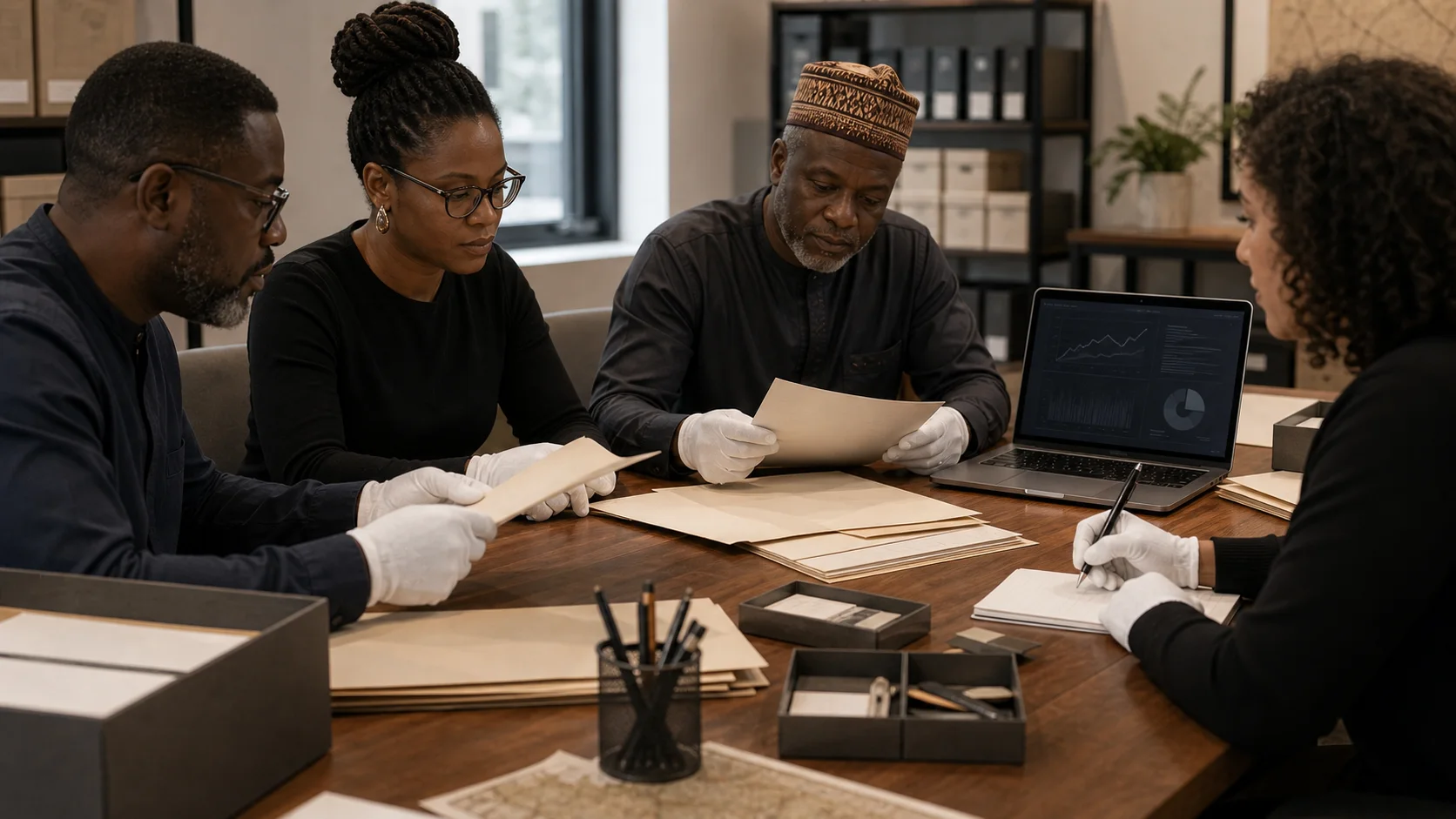
A restitution headline tells readers that an institution has moved, but archive evidence tells them why the move was necessary, what was returned, who has authority now and what remains unresolved. For the Benin Bronzes, this distinction is essential. The 1897 British attack on Benin City scattered objects, photographs, letters, catalogues, dealer records, expedition names, accession files and oral histories across many institutions. A serious campaign cannot rely on emotion alone. It has to teach the public how evidence is built and how that evidence should lead toward Nigerian authority.
Archive evidence is not a cold alternative to cultural memory. It is one way cultural memory becomes harder to deny in public. A photograph may show members of the expedition surrounded by palace material. A museum record may name a donor who served in the military campaign. A sales catalogue may show how objects moved into the art market. An institutional return statement may explain when title transferred and whether physical custody changed. Each source is partial, but together they make a chain that readers can test.
This guide is written for campaign readers, families, educators, journalists and diaspora groups who want to understand the research without pretending to be museum lawyers. The practical aim is simple: learn how to ask evidence-based questions. Which archive is being cited? Which object is linked to which record? Does the source name 1897 directly? Does it show Nigerian institutional authority? Does it distinguish legal title, physical custody, digital access and public education? Restitution becomes stronger when supporters can follow the record rather than only repeat a slogan.
Begin with the source event: Benin City in 1897
Every evidence chain has to begin with the source event. The British Museum's public Benin Bronzes history states that British forces looted shrines and associated compounds, took thousands of ceremonial and ritual objects, and distributed or retained material as official spoils of war. It also describes more than 900 brass relief plaques removed from a palace storage room and explains that the occupation ended the independent Kingdom of Benin. Those facts are not campaign rhetoric. They are part of the public institutional record.
National Museums Scotland gives readers another clear example of how museums now describe the raid. Its public page says British troops occupied and ransacked the royal palace, looted thousands of objects of immense cultural value, and that many were auctioned by the British Admiralty to help cover the costs of the venture. It also explains that William Downing Webster sold many Benin works to museums and collectors across Europe after buying from Admiralty auctions and expedition members. This is exactly the kind of language readers should look for: a chain from violence to market to museum.
A good article, label or teaching packet should not begin as if the object simply appeared in a collection. It should separate the original removal from the later museum acquisition. A record may say purchased in 1903, donated in 1925 or acquired from a private collection in 1954. Those dates matter, but they are not the first moral date. The public question is whether the later acquisition was made possible by the 1897 attack, looting and sale of Benin court material.
Digital Benin turns dispersed evidence into a research field
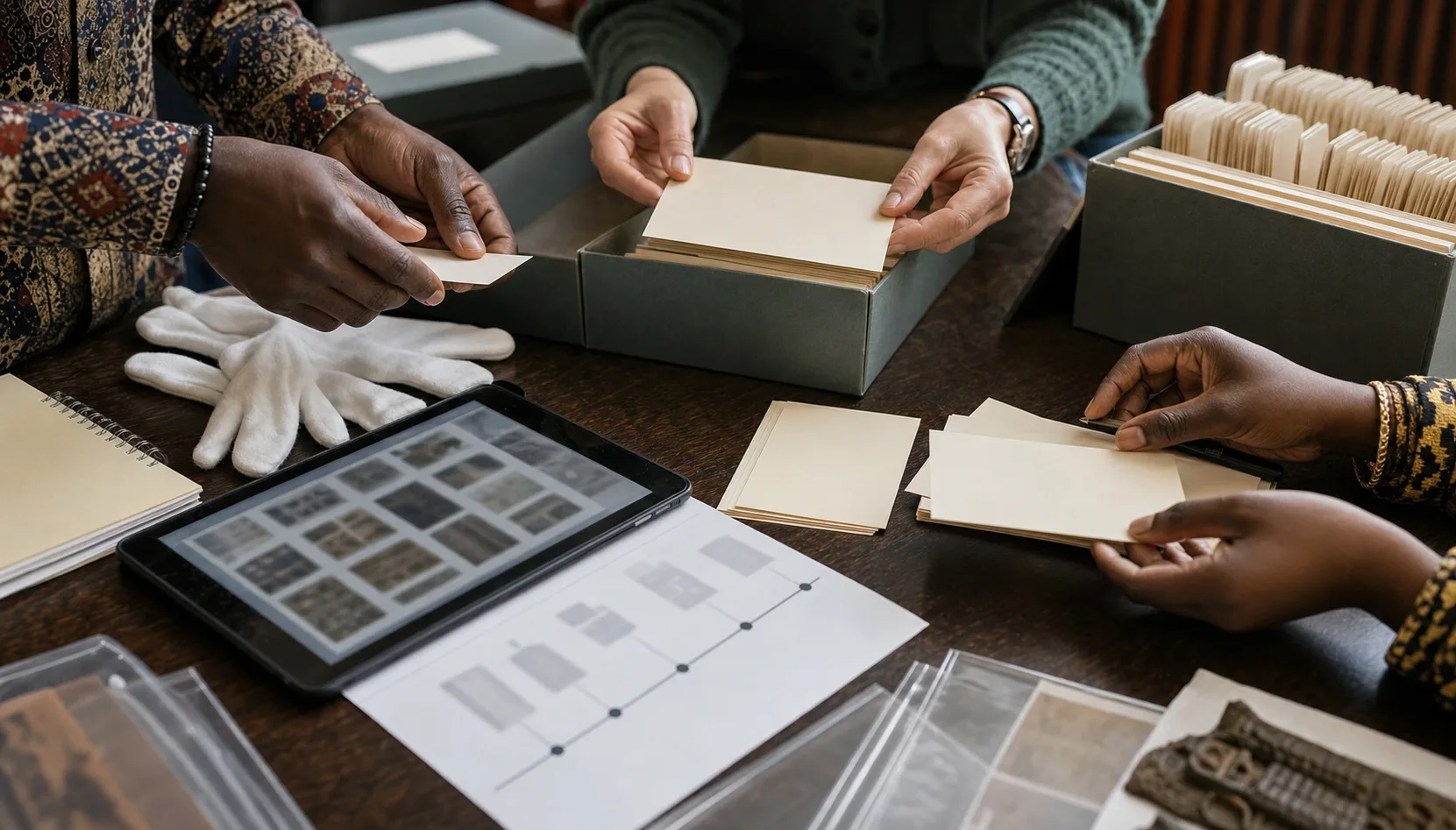
Digital Benin is central because it treats Benin heritage as a connected field rather than a set of isolated museum pages. Its current platform lets readers search, filter and explore data, images and linked research for 5,304 objects from 139 institutions in 21 countries. It also includes provenance names, a present-day map, oral history, Edo designations, Itan Edo cultural history, archival documents, archival institutions and digital research tools. That combination matters because the 1897 dispersal was not only a physical dispersal. It was also a dispersal of knowledge.
The provenance section is especially useful for public readers. Digital Benin states that the question of ties to the British colonial military campaign on Benin City is central to considering the objects now dispersed across at least 139 institutions. The platform links names, roles and object relations, making it possible to see how expedition members, dealers, collectors and institutions recur across records. A single museum page may look narrow; the connected provenance field shows patterns.
Digital Benin should not be treated as a magic answer machine. It is a research tool, not a substitute for Nigerian governance, physical return or direct institutional accountability. But it gives campaign readers a stronger method. Open the object record. Check the holding institution. Look for provenance names. Compare archive documents where available. Ask whether the museum has updated its own record after return, title transfer or new research. The platform helps readers move from general concern to evidence they can cite.
Archive documents show the paperwork behind possession
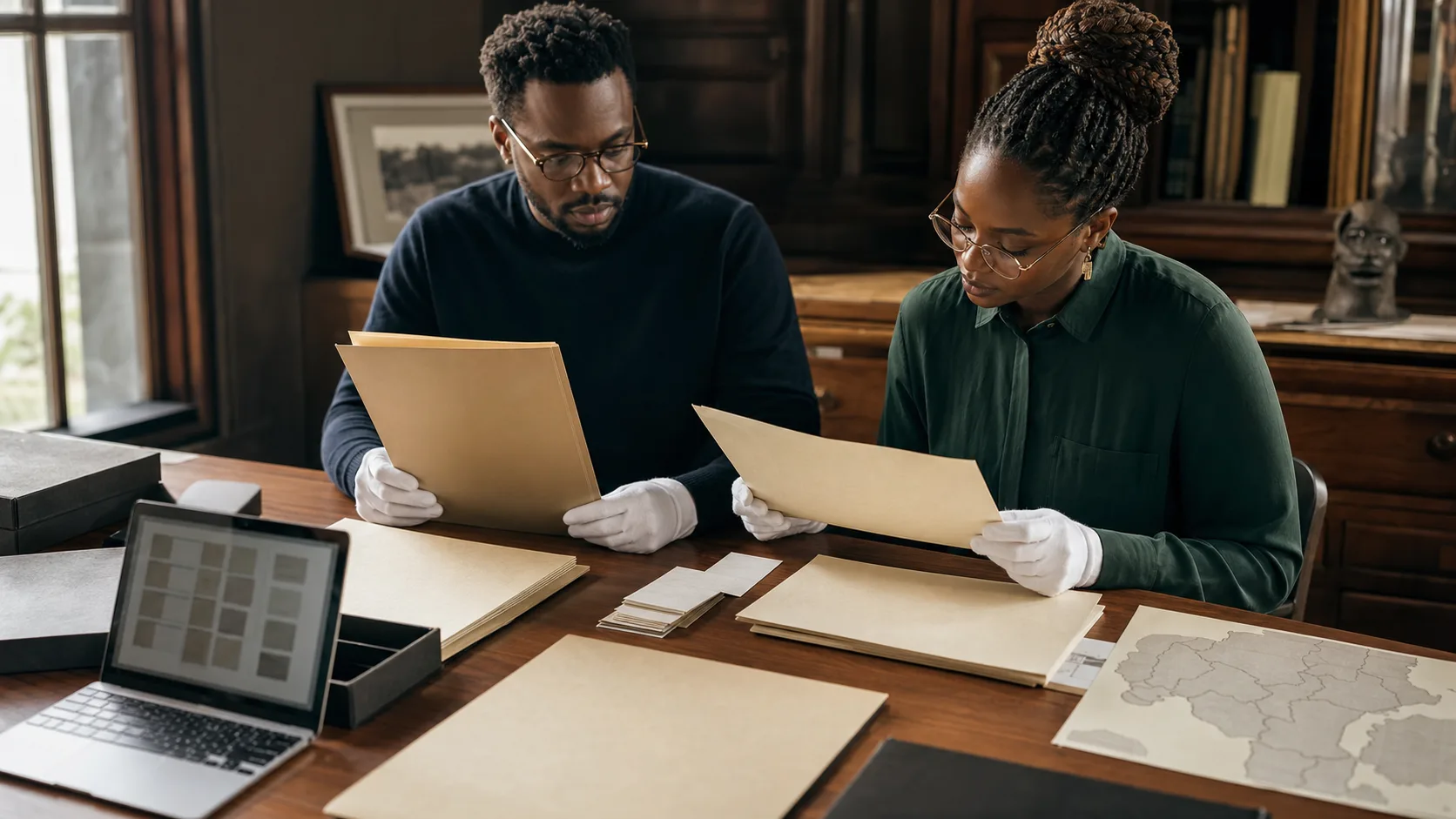
Digital Benin's archival documents section is important because it acknowledges a second kind of dispersal: the relevant documents are scattered globally just as the objects are. The platform says the documents are not comprehensive, but are identified and brought together because they are relevant to the historic objects and the wider history of the Benin Kingdom. That caveat is valuable. Serious research does not claim false completeness. It shows what exists, what is missing and what still needs to be opened.
The document types themselves teach readers what to search for. Correspondence, auction catalogues, sales catalogues, annual reports, contracts, metadata finding aids, diaries and sound recordings can all shape a provenance claim. An auction catalogue may not prove everything, but it can show that an object group circulated through a specific market. A diary may not identify every object, but it can place a military or collecting actor in the relevant chain. A contract may show a modern title transfer. A finding aid may point toward records that are not digitized yet.
The practical campaign habit is to cite documents with humility. Do not turn one archive hit into a final verdict when the chain is incomplete. Instead, state what the document shows, what it does not show and what question it raises. This is stronger than exaggeration. A museum, collector or journalist can dismiss unsupported claims. It is harder to dismiss a careful question grounded in a named source, a date, an object group, a provenance name and a clear request for institutional clarification.
Colonial photographs need ethical handling
Photographs are powerful evidence, but they are not neutral. The British Museum collection includes an 1897 photographic print by Dr Robert Allman, principal medical officer on the British Expedition to Benin City, described as showing European members of the expedition surrounded by objects from the royal palace, shrines and compounds. Such images can document possession, location and context. They can also reproduce the gaze and violence of the colonial moment if they are circulated without care.
Digital Benin's archival institutions section addresses this problem directly. It explains that the archive includes descriptions, digitized material, links to resources not yet digitized and more than 900 photographs received from institutions that are under review by a working group. It notes that many colonial photographs document desecration, looting, the Benin royal palace and the journey of the Bronzes out of Nigeria, and that they can be contested and distressing because they represent violence, theft, appropriation and sale of cultural property.
For Reclaim Your DNA readers, the rule is not to hide evidence, and it is not to display painful images carelessly. The responsible approach is contextual. Use photographs to ask what they prove, who produced them, who is shown, what objects appear, where the image was taken and whether Nigerian or Edo authority has shaped the caption. Avoid turning colonial trophy images into shareable spectacle. Evidence should repair public memory, not repeat the extraction that created the archive.
Archaeology and conservation records are part of the archive too
Archive evidence is not limited to nineteenth-century paper. Current archaeology, conservation and heritage-management records also shape the future of restitution. MOWAA's work in Benin City and the MOWAA Archaeology Project materials published through the British Museum point toward a wider infrastructure question: how can returned heritage be studied, conserved, contextualized and made accessible under Nigerian leadership? The answer depends on records as much as buildings.
A returned object needs condition reports, conservation notes, storage records, exhibition plans, teaching materials, image permissions, loan documents and public access updates. Those files may sound technical, but they determine whether restitution becomes visible and durable. If an object returns without a public record, a clear authority statement or a plan for educational access, the public may still struggle to understand what changed. If the record is open enough, the return becomes a civic resource.
This is why archive justice has two directions. It looks backward to the 1897 removal, military actors, dealers, auctions and museum acquisition. It also looks forward to Nigerian-led documentation, conservation training, public programming, digital museum access and school materials. A campaign that asks for return should also ask for the records that let Nigerians and the diaspora study the return after the ceremony ends.

Recent returns show provenance research becoming public action
The archive question is current, not only historical. In June 2026, the Swiss Confederation announced that three Swiss museums returned eighteen artefacts from the Kingdom of Benin to Nigeria, and said the restitution was the outcome of provenance research under the Benin Initiative Switzerland. The same announcement described a transfer ceremony at the National Museum in Lagos, formal receipt by the National Commission for Museums and Monuments, and a cultural property agreement aimed at combating illicit trade and protecting heritage.
The University of Zurich's March 2026 announcement is similarly useful for readers because it names provenance research as the basis for action. UZH said research at its Ethnographic Museum showed that the majority of the objects had very likely been looted before the university acquired them, and that fourteen objects would be transferred to the Nigerian National Museum in Lagos for handover to NCMM. This is what an evidence chain should do: move from research to decision, public statement and accountable transfer.
The Netherlands return in 2025 and other institutional transfers show the same lesson at larger scale. Restitution is not made credible by ceremony alone. It is made credible when the public can see who researched the objects, what evidence was considered, who received authority, what title changed, where the objects are held, and how future access will be handled. Provenance research should not be a permanent waiting room. When the evidence is strong, it should become public action.
A practical archive checklist for campaign readers
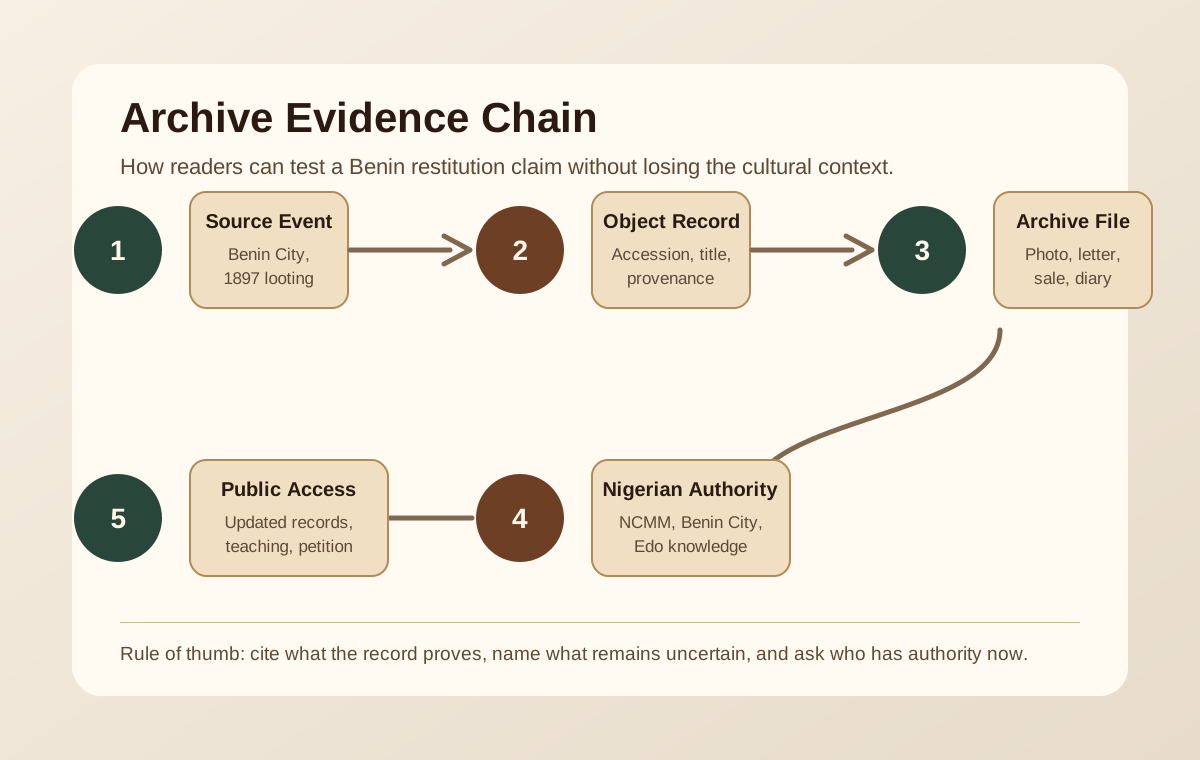
Start with one object, one institution or one return announcement. Write down the title, accession number, current holder, claimed origin, acquisition date, donor or dealer, image credit and source URL. Then open Digital Benin and search the object, institution, object group or provenance name. If a record exists, compare how each source describes the object, the 1897 connection, the ownership status and the public access route. If a record does not exist, note that absence without treating it as proof.
Next, look for archive layers. Does the institution link to correspondence, photographs, auction catalogues, acquisition registers, donor papers, condition reports or return agreements? Does it explain whether those records are digitized or only available by appointment? Does it name sensitive material that needs careful access? Does it provide a correction route for Nigerian institutions, Edo knowledge holders, researchers or families? A serious record should tell readers how to move from the public summary to the evidence file.
Finally, turn the reading into a precise question. Ask the museum to clarify whether title has transferred. Ask whether a loan is Nigerian-approved. Ask why a colonial photograph is captioned in a certain way. Ask whether Digital Benin links will be added. Ask whether Nigerian or Edo authority reviewed the record. Ask whether an archive finding aid will be opened. Precise questions are useful because they create a public trail that institutions can answer, update or refuse.
How educators can teach archive evidence without overwhelming students
Archive teaching should begin with a small packet, not a giant database. Choose one public museum record, one Digital Benin page, one return announcement and one archive document or photograph. Ask students to identify what each source can prove. The museum record may show accession history. Digital Benin may show connected provenance names. The return announcement may show legal action. The photograph may show colonial possession and context. The lesson is that public history is built by comparing sources.
Students should also learn to separate evidence from interpretation. Evidence might be a date, a named expedition member, an auction catalogue, a photograph location, a title-transfer announcement or a Nigerian institutional statement. Interpretation is the argument made from those facts. Good interpretation should explain uncertainty rather than hide it. If students learn this distinction, they become harder to mislead by vague museum language, social media claims or market descriptions that use prestige instead of proof.
Diaspora families and community groups can use the same method. A workshop does not need rare archive access to be meaningful. It can teach participants to read public records, follow internal links, respect sensitive images, cite Nigerian sources and support the petition with better public literacy. The goal is not to turn every supporter into a specialist. The goal is to make the restitution conversation more exact, more teachable and more difficult to dismiss.
Takeaways for museums, archives and supporters
Museums should publish archive links beside Benin object records wherever possible. They should state whether an object is tied to 1897, which records support that statement, which parts of the chain remain uncertain, and whether Nigerian authority has shaped the current record. They should avoid passive language that hides removal, sale or transfer. They should also create access routes for documents that cannot yet be fully digitized.
Archives should treat colonial photographs and expedition files as contested cultural evidence, not ordinary historical curiosities. Description, access and reuse rules should account for violence, distress, cultural sensitivity and Nigerian interpretive authority. Opening the archive does not mean stripping it of care. It means making the evidence usable for repair while refusing to repeat colonial spectacle.
Supporters should leave this guide with one habit: ask for the evidence chain. Do not stop at a headline, a beautiful image or a vague acquisition date. Look for the source event, the object record, the provenance name, the archive document, the return statement, the title status, the custody plan and the Nigerian public access route. Then share the campaign background, use the research library and sign the petition. Archive evidence is how public memory becomes public pressure.
Frequently Asked Questions
What counts as archive evidence for Benin Bronzes restitution?
Archive evidence can include museum accession files, expedition photographs, correspondence, auction catalogues, sales records, diaries, donor papers, provenance databases, return agreements, condition reports and Nigerian institutional statements.
Why is Digital Benin important for archive research?
Digital Benin connects object records, provenance names, archival documents, institutions, oral history, maps and Edo designations across many holding institutions, making scattered evidence easier to compare responsibly.
Should colonial photographs of the 1897 looting be shared?
They can be important evidence, but they should be handled with context, sensitivity and Nigerian or Edo interpretive authority. They should not be used as spectacle or stripped from the violence they document.
What should readers ask museums after finding an archive record?
Ask what the record proves, what remains uncertain, whether the object is linked to 1897, whether title or custody has changed, whether Nigerian authority is visible, and whether public records will be updated.
References and Further Reading
- Digital Benin
- Digital Benin: Catalogue
- Digital Benin: Provenance
- Digital Benin: Archival Documents
- Digital Benin: Archival Institutions
- British Museum: Benin Bronzes
- British Museum: Dr Robert Allman 1897 photographic print
- National Museums Scotland: The British raid on Benin 1897
- National Commission for Museums and Monuments
- Museum of West African Art
- MOWAA: Archaeology and heritage management
- British Museum PDF: MOWAA Archaeology Project, Benin City
- Swiss Confederation: Swiss museums return 18 major artefacts to Nigeria
- University of Zurich: UZH returns Benin Bronzes to Nigeria
- Government of the Netherlands: 119 Benin Bronzes returning home
- UNESCO: Return and restitution
- ICOM: Code of Ethics