This guide is part of the Reclaim Your DNA research library. It helps readers understand Nigerian heritage, the Benin Bronzes, the 1897 looting of Benin City, and the modern movement for cultural restitution through context, evidence and a concrete path to action.
Begin with the Reclaim Your DNA campaign background, support the petition, and use the wider research library to connect digital access with return, public records and diaspora action. This guide belongs beside our articles on Digital Benin and provenance research, museum object records, Nigerian public records, and teaching the Benin Bronzes.
Why image rights now belong in the restitution conversation
Restitution is usually discussed through ownership, custody and physical return. Those questions remain central, but they do not exhaust the public problem created by the 1897 looting of Benin City. A student may never touch a returned object, yet still meet it through a museum photograph, a catalogue thumbnail, a classroom slide, a social post, a database export or an archive scan. If the image cannot be reused, corrected, cited or explained clearly, the public record remains partly locked even when the historical evidence is visible.
For Benin heritage, images are not neutral decorations. They shape which objects people recognize, which names circulate, which institutions appear authoritative and which communities can teach the history. A foreign museum may hold a high-quality image and a carefully maintained database, while Nigerian families, teachers and diaspora groups see only a low-resolution thumbnail or a restrictive license note. That imbalance is not the same as physical possession, but it belongs to the same field of cultural power.
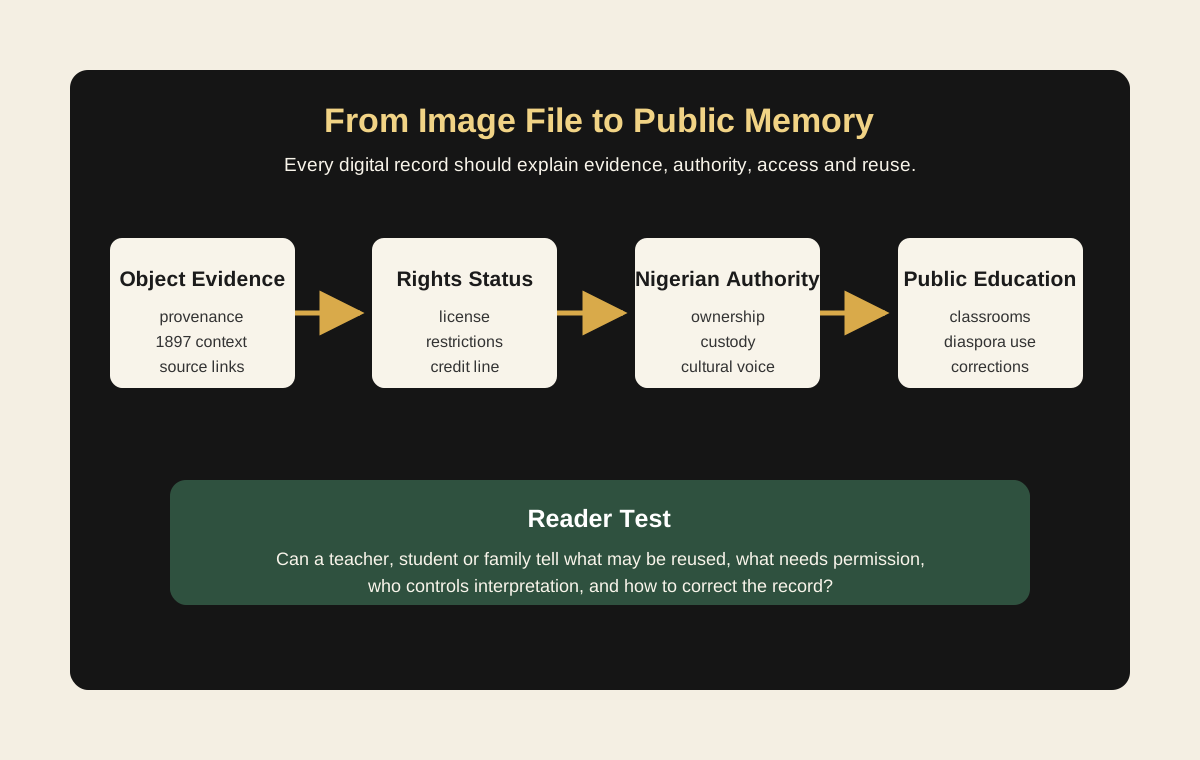
A serious campaign should therefore ask a plain question after every return announcement and every new catalogue project: can the public use the record responsibly? The answer should cover provenance evidence, image permissions, credit lines, cultural sensitivity, Nigerian authority, correction routes and educational reuse. Open access is not a substitute for restitution. It is one of the ways restitution becomes teachable, searchable and accountable in daily life.
Digital Benin shows what connected records can do
Digital Benin is the strongest starting point because it treats dispersed objects as a connected research field rather than isolated museum trophies. Its platform brings together data, images, linked research, provenance names, Edo designations, oral histories, archival documents and maps for thousands of historic Benin objects across institutions and countries. That model matters because the 1897 looting produced not only a physical scatter but also a knowledge scatter: object names, acquisition dates, old photographs, expedition names, dealer routes and local meanings were separated into many systems.
The catalogue is especially useful for readers because it makes rights status part of the record. A person studying an object should not have to guess whether an image can be used in a school handout, a community presentation, a research post or a public campaign. A rights field does not answer every ethical question, but it forces the record to state a practical condition. That practical condition is what allows responsible reuse instead of either careless copying or unnecessary silence.
Digital Benin also reminds campaign readers that access is not only about images. The Edo-language material, oral histories and historical context are just as important as the visual file. An image without cultural framing can become another extractive object, circulated for its beauty while its authority remains foreign. A better record lets a reader see the object, compare provenance, understand designations, follow archival links and ask who is authorized to explain meaning.
The 1897 history makes licensing more than a technical issue
The British Museum's own Benin Bronzes page states the core history directly: Benin City was captured by British forces in February 1897, the palace was burned and looted, and thousands of ceremonial and ritual objects were taken as official spoils of war or distributed among members of the expedition. The same page explains that many objects moved through sales, donations, museums and private collectors. For readers, that history changes how image rights should be understood. A photograph of a looted object is not only a file owned or controlled by the institution that made the photograph.
This does not mean every digital image should be treated carelessly or that all restrictions are illegitimate. Some materials may involve cultural sensitivity, third-party rights, conservation limits, sacred meanings, living community concerns or privacy issues in modern documentation. The point is different: restrictions should be explained, not hidden. If a museum restricts image reuse, the public should know whether the reason is copyright, commercial policy, cultural sensitivity, donor rights, incomplete records or another factor.
That distinction matters because a restrictive license can protect community interests, but it can also protect institutional control. A source-backed campaign has to tell the difference. If Nigerian or Edo cultural authority asks that a certain image not circulate freely, responsible readers should respect that. If a foreign institution limits educational reuse mainly to preserve licensing revenue or brand control over a contested object, readers can challenge that policy while still crediting the source record accurately.
Compare restricted reuse with open access models
The British Museum's copyright and permissions page says it increasingly intends to release website content under a Creative Commons Attribution-NonCommercial-ShareAlike license, while also making clear that not everything on its website is covered and that some material has third-party rights or cultural sensitivities. That is useful information, but it leaves many practical limits. Non-commercial restrictions, share-alike conditions and separate image licensing routes can still make educational publication complicated for community groups, small publishers, teachers and diaspora advocates.
The Smithsonian offers a different comparison through its Open Access program. Its official pages describe millions of digital items released into the public domain under Creative Commons Zero, with permission to download, share, transform and reuse open access assets without asking the Smithsonian, while still warning that third-party, trademark, privacy, publicity or cultural restrictions may apply. That model is not perfect for every culturally sensitive collection, but it shows that major institutions can separate public-domain access from institutional fear.
For Benin Bronzes advocacy, the lesson is not simply that every museum should copy one policy. The better lesson is that every institution should make its access logic public. Which records are open? Which images are restricted? Which restrictions come from cultural responsibility rather than institutional revenue? Which metadata can be reused even when an image cannot? Which contact route allows a Nigerian institution, teacher, researcher or family to request clarification? Without those answers, the public cannot distinguish access from permission theater.
Nigerian authority has to shape digital access
Open access can be ethically weak if it treats source communities as absent. A foreign museum can release a beautiful photograph into broad reuse while still failing to update ownership status, Edo designations, provenance language or Nigerian interpretive authority. That would increase circulation without repairing voice. For Reclaim Your DNA readers, the better standard is Nigerian-led access: records and images should become more useful because Nigerian institutions and Edo cultural authorities help define what the public needs to know.
Nigeria's National Commission for Museums and Monuments is central because it is responsible for national museum stewardship, preservation and public presentation. Its digital museum work and public restitution updates show that access is not only a foreign museum service. Nigerian institutions can publish records, build digital tools, support education and connect returned objects to national audiences. The practical question is whether foreign holders update their systems to point toward that authority when title, custody or interpretation changes.
This is also where Benin City cultural memory matters. The objects came from a court, guild and ritual world with living descendants, institutions and knowledge systems. A rights statement should not reduce the question to copyright alone. It should ask who can name the object, who can correct old language, who can decide whether an image is sensitive, who can approve educational use and who benefits when the image circulates. Digital access is strongest when it moves institutional voice toward shared authority.
What a responsible object image record should include
A useful public record should begin with identity. It should state the object title, Edo designation where known, accession number, material, approximate date, production place, current holding institution and link to the source record. It should then name the provenance status in plain language: whether the object is linked to the 1897 British expedition, whether the chain is incomplete, whether ownership has transferred, whether custody has changed, and whether a restitution claim or agreement exists.
The rights layer should be just as plain. A reader should see the image license, credit line, permitted uses, restricted uses, commercial-use rule, download options, metadata reuse rule, and contact route for permissions or corrections. If the image is not open, the record should say why. If the restriction is cultural sensitivity, it should say that respectfully without exposing protected details. If the restriction is institutional licensing, it should not be disguised as ethics.
The education layer should close the loop. A responsible record should link to Digital Benin where available, Nigerian institutional updates, teaching resources, oral-history material, public-access plans and related return announcements. It should help a teacher create a lesson without guessing. It should help a journalist avoid a misleading caption. It should help a diaspora family explain why the object matters. It should also make correction possible when old labels, harmful terminology or incomplete acquisition language remain in the record.
Public-domain access does not cancel cultural care
Some open access debates become too simple. One side treats restriction as censorship; the other treats openness as disrespect. Benin heritage requires a more disciplined position. A campaign can support wider educational access while also recognizing that not every image should circulate without context. Sacred meaning, ritual restriction, painful colonial photographs, human remains policies, community requests and current security concerns may all create legitimate limits. The key is accountable explanation.
UNESCO's return and restitution work helps frame the issue as cooperation, not only ownership dispute. Cultural property claims require records, communication and processes that both parties can understand. Digital access should follow the same logic. A museum that holds Benin material should not make Nigerian institutions chase vague permissions across departments. A Nigerian teacher should not need legal training to know whether a catalogue image can be placed in a free classroom packet. A diaspora group should not have to choose between silence and risky reuse.
Cultural care also means avoiding fake abundance. A platform can display thousands of thumbnails and still be weak if the metadata is poor, the images are locked, the history is euphemistic and the correction route is invisible. Real access is not a gallery of files. It is a public system that lets people understand, cite, teach, question and repair the record under the authority of the culture from which the objects came.
How readers can audit image rights in ten minutes
Start with one object or one institution. Open the museum record and write down the title, accession number, provenance language, image credit and license statement. Then open Digital Benin and compare the record if the object or institution is listed there. Look for a rights field, source link, Edo designation, related provenance names and any indication of legal status or display status. The goal is not to become a lawyer. The goal is to make the public record visible enough to discuss accurately.
Next, ask four practical questions. Can I download the image? Can I use it in a free classroom or community presentation? Can I publish it in a research blog or campaign explainer with credit? Can a commercial platform use it, and should it? If the answer is unclear, note the ambiguity. Ambiguity is itself a finding because public access fails when ordinary readers cannot tell what responsible use looks like.
Finally, separate rights from ethics. If an image is legally reusable but culturally sensitive, treat the cultural issue seriously. If an image is restricted by a foreign museum but the object is clearly part of the 1897 Benin dispersal, ask why the restriction exists and whether Nigerian authority has shaped it. Then share the question, not just the image. A strong campaign trains readers to ask better public questions rather than simply collecting more pictures.
Why this matters for schools, families and diaspora campaigns
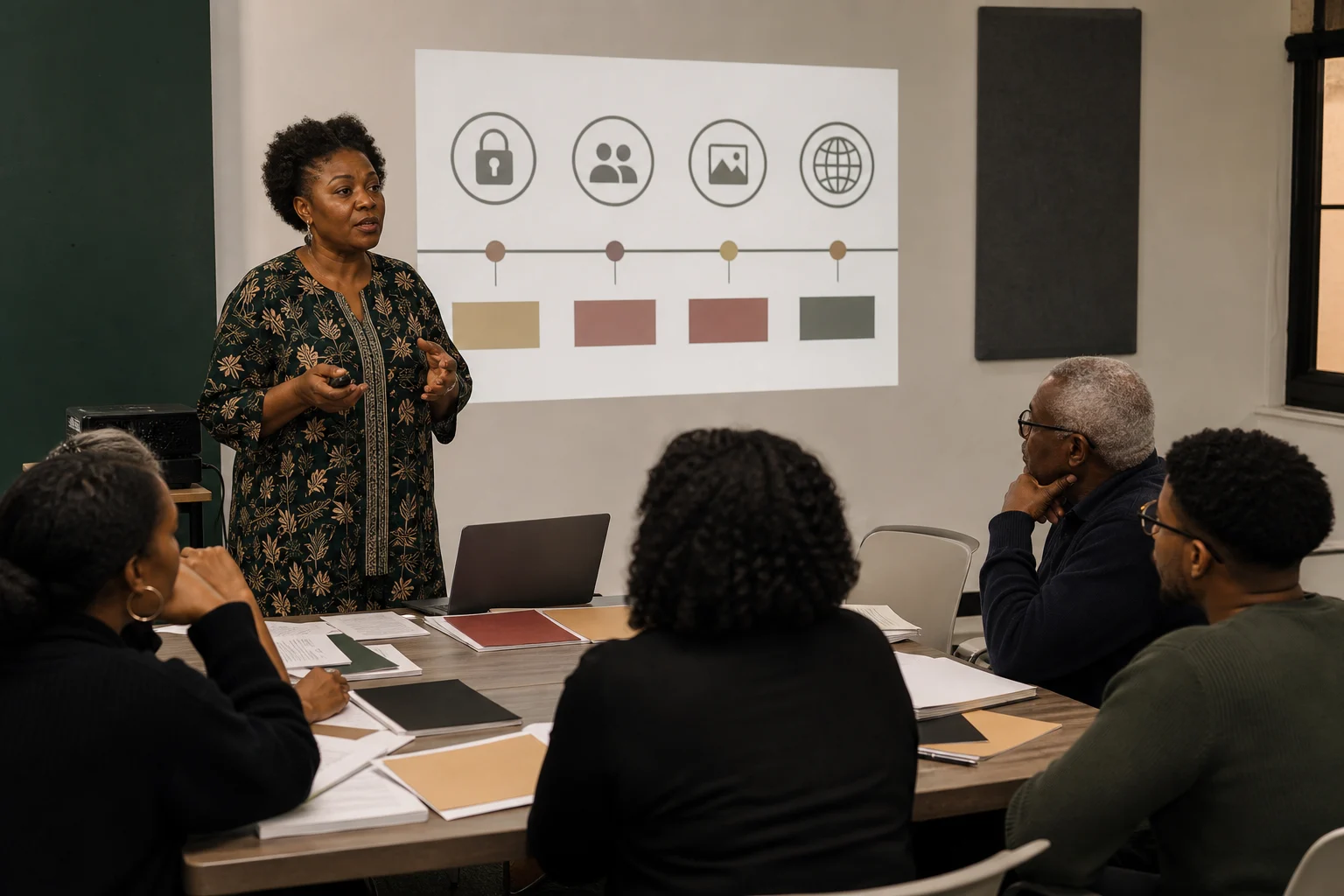
Education needs usable materials. A teacher explaining the 1897 looting of Benin City should be able to show students how an object record works, what a provenance note says, how a license limits reuse and why Nigerian authority matters. A family discussing heritage should be able to open a reliable page, compare names and understand why return is about more than museum display. A diaspora campaign should be able to cite sources without accidentally spreading misleading captions or unauthorized images.
Image rights also shape search visibility. The images that are easiest to reuse often become the images that dominate articles, school slides, social feeds and AI training discussions. If responsible records are locked while low-quality or context-free images circulate freely, public memory tilts toward the least accountable sources. This is why serious search work and serious cultural work overlap: the best records should be the easiest records to find, cite and teach.
Reclaim Your DNA can use this issue to move supporters from emotion to practice. Sign the petition, but also audit a record. Share the campaign background, but also ask a museum whether its Benin images have clear educational terms. Read a return announcement, but also check whether the object page changed after title transfer. When supporters learn to inspect the rights layer, they make restitution harder to reduce to a ceremony.
Takeaways for museums, platforms and campaign readers
Museums should publish image rights in plain language beside every Benin object record. They should distinguish copyright, cultural sensitivity, third-party rights, commercial policy and Nigerian authority. They should update records after title transfer or return. They should point users toward Digital Benin and Nigerian institutional sources. They should create correction routes that do not require insider knowledge. Above all, they should stop treating image control as a quiet extension of object control.
Digital platforms should make records interoperable without flattening cultural meaning. Search, filters, API fields and downloadable metadata are useful only when they carry provenance, rights, source links and interpretive responsibility. Open access should not mean stripping the object from its history. It should mean giving teachers, families, researchers and journalists enough reliable information to use the image responsibly and to know when not to use it.
Campaign readers should treat image rights as part of restitution literacy. Ask what can be reused, who controls the terms, how Nigerian authority is shown, and whether old records have been corrected. Use open material with credit even when credit is not required. Respect culturally sensitive limits when they are clearly grounded. Challenge institutional restrictions when they preserve colonial control. The aim is not to win a license argument. The aim is to return cultural memory to public use under accountable Nigerian and Edo authority.
Frequently Asked Questions
Why do image rights matter for Benin Bronzes restitution?
Because many people meet Benin heritage through digital records, photographs and classroom materials. If those files are locked, unclear or disconnected from Nigerian authority, public memory remains partly controlled by former holders.
Is open access the same as restitution?
No. Open access can support education and accountability, but it does not replace title transfer, physical return, Nigerian custody or Edo cultural authority.
Should every image of a Benin object be freely reusable?
Not automatically. Some images may need limits because of cultural sensitivity, third-party rights or community requests. The key is that restrictions should be clearly explained and shaped by the right authority.
What should readers check before reusing a museum image?
Check the license, credit line, permitted uses, commercial-use rule, cultural sensitivity note, source URL, provenance context and whether Nigerian authority or Digital Benin is linked.
References and Further Reading
- Digital Benin
- Digital Benin: Catalogue
- British Museum: Benin Bronzes
- British Museum: Copyright and permissions
- Smithsonian: return of 29 Benin Bronzes
- Smithsonian: Open Access
- Smithsonian: Open Access FAQ
- National Commission for Museums and Monuments
- NCMM: Digital Museum partnership
- UNESCO: Return and restitution
- ICOM: Code of Ethics